[Redacted] Characters & Enemies
For [Redacted], I had the chance to lead character development, collaborating closely with my peers on NPCs, enemy units, and boss characters. With a top-down camera and a cel-shaded aesthetic, the focus was on strong silhouettes and visual gameplay clarity from a distance. With the top-down camera and cel-shaded aesthetic, we selectively used normal maps and high-res sculpts—focusing only on assets where the added detail and depth made a meaningful impact relative to their on-screen pixel space. We also reauthored select assets from The Callisto Protocol to accelerate development while creating new content tailored to [Redacted]’s unique gameplay and tone.
The project had a fast-paced production cycle for some of us—just a little over a year from start to finish—and was incredibly rewarding to work on. I’ve already sunk an ungodly number of hours into it on the Steam Deck! 🎮🎮🎮
As always, building characters is a highly collaborative effort. Huge thanks to the concept artists, tech artists, material artist, animators, VFX, engineers, and directors who helped bring it all together. Special shout-out to Amanda Stewart who created the Post-Processing Material to drive home that cell shaded aesthetic. 🙌

A $#@&ING Crane Boss, animated .gif of the grinder extensions.

A $#@&ING Crane Boss, in A-Pose. This was a fun boss to work on, especially with all the animated parts needed to support gameplay and design needs.

Sentient boss: The tentacles were a technical challenge. To achieve the overlapping look we wanted, I layered and combined multiple tentacles—an approach that simplified the rig, preserved the visual intent, and still allowed animation to do their thing.

Sentient boss and supporting attack assets.

Rival NPC: Liz Harry the Lunch Lady.

Rival NPC: Zach Stern the Nerd.

Rival NPC: Dr. Patti Lin the Psychiatrist.

Rival NPC: Bob Bleckman from Accounting.

Rival NPC: Joanie Smith the Karen

Rival NPC: Ronnie Flagg the Punk.
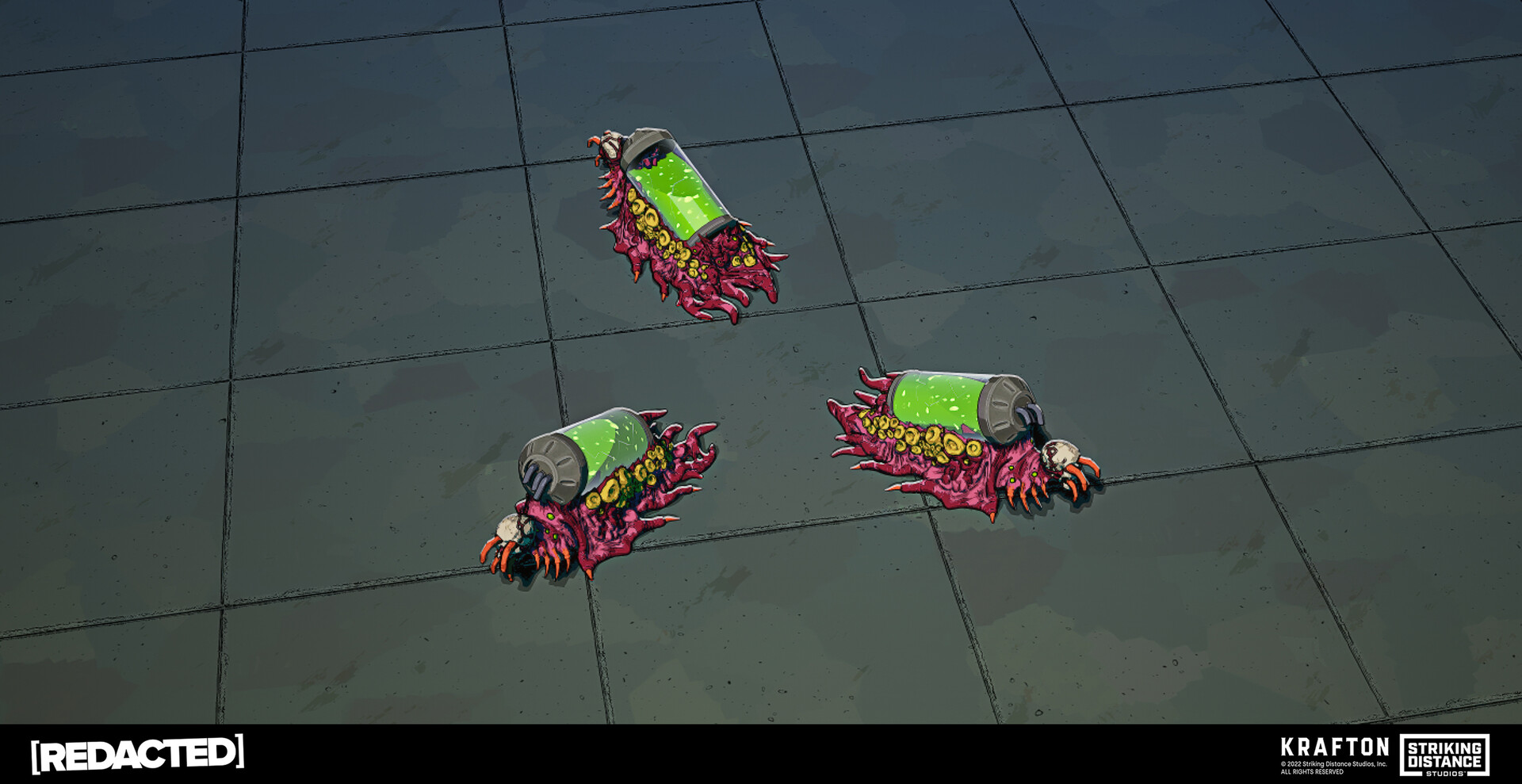
Enemy: Acid Snail. Principal Materials Artist, Amanda Stewart created an awesome animated liquid material that sloshes and moves around inside the canister vat—really bringing the design to life!

Enemy: Armless Braintank.

Enemy: Turret

Ideas and iterations of development. Design needed to add a “Duster” attack, so I mocked up a few ideas to explore the idea and see what would stick.

Ideas and iterations of development. Design needed to add a “Duster” attack, so I mocked up a few ideas to explore the idea and see what would stick.

Ideas and iterations during development. Design called for some large grinders to emerge from the crane, fully extending across the area to attack the player and block their path forward. Here are a few basic mock-ups I created to help communicate ideas.

Ideas and iterations during development. Design called for some large grinders to emerge from the crane, fully extending across the area to attack the player and block their path forward. Here are a few basic mock-ups I created to help communicate ideas.

Ideas and iterations during development. Design called for some large grinders to emerge from the crane, fully extending across the area to attack the player and block their path forward. Here are a few basic mock-ups I created to help communicate ideas.

Ideas and iterations during development: Quick mock-ups to help communicate ideas to the team.

Ideas and iterations during development: Quick mock-ups to help communicate ideas to the team.

Different stages of development.

We authored the guns as low-poly assets with no baked maps, given the minimal screen pixel space they occupy in-game. This kept the workflow efficient while preserving clarity from a top-down view.
![There was quite a bit of reuse and kitbashing from TCP for [Redacted]—including enemy assets that were heavily simplified and re-textured to match the style of the project.](https://cdna.artstation.com/p/assets/images/images/086/884/802/large/michael-svymbersky-redacted-xmisc-01-msvymbersky.jpg?1744306468)
There was quite a bit of reuse and kitbashing from TCP for [Redacted]—including enemy assets that were heavily simplified and re-textured to match the style of the project.
![There was quite a bit of reuse and kitbashing from TCP for [Redacted]—including enemy assets that were heavily simplified and re-textured to match the style of the project.](https://cdnb.artstation.com/p/assets/images/images/086/884/805/large/michael-svymbersky-redacted-xmisc-02-msvymbersky.jpg?1744306473)
There was quite a bit of reuse and kitbashing from TCP for [Redacted]—including enemy assets that were heavily simplified and re-textured to match the style of the project.
![There was quite a bit of reuse and kitbashing from TCP for [Redacted]—including enemy assets that were heavily simplified and re-textured to match the style of the project.](https://cdnb.artstation.com/p/assets/images/images/086/884/823/large/michael-svymbersky-redacted-xmisc-04-msvymbersky.jpg?1744306490)
There was quite a bit of reuse and kitbashing from TCP for [Redacted]—including enemy assets that were heavily simplified and re-textured to match the style of the project.
if you’re a fan of top-down roguelikes, it’s definitely a must-play! 🙌🎮